Location course · £49
Lower Slaughter Village
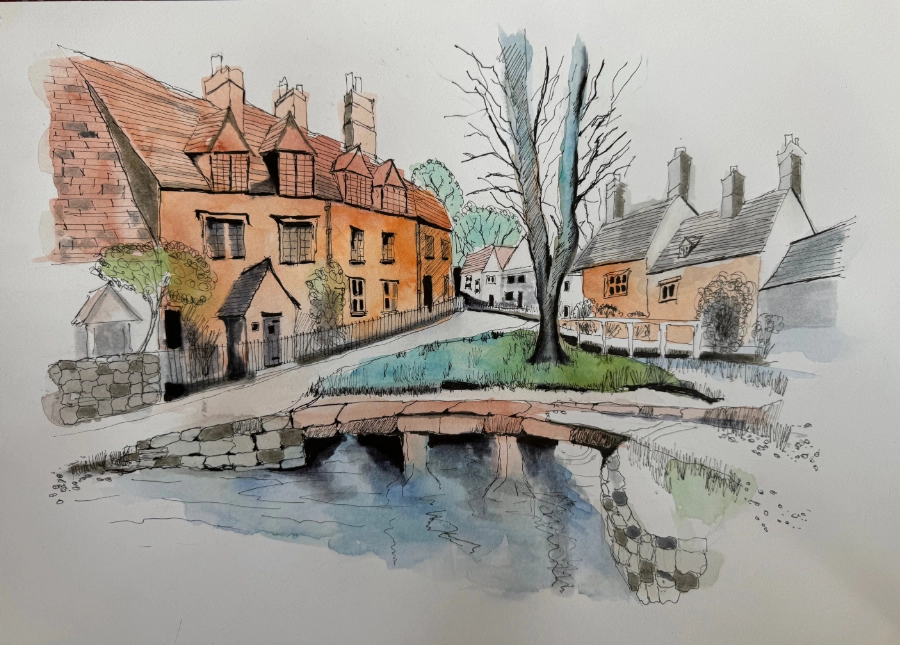
A Cotswold village where time seems to have stopped — honey-coloured limestone cottages, tiny stone footbridges, and the River Eye running quietly through the middle of it all.
About this course
Why Lower Slaughter looks impossible — and isn't
The honey-coloured limestone catches the light differently on every surface. The stonework is textured and irregular — centuries of repair and rebuilding layered into the walls. The River Eye shifts constantly between silver, green, and deep brown shadow.
Here's what beginners don't realise: all of that complexity is your friend. When a scene is this layered and alive, there's no single correct version of it — your palette choices, the way your brush moves, the slight uncertainty in your line, aren't mistakes. They're the painting finding its own truth. The four-stage process gives you the structure to respond to it confidently.
Read more about the four stages →This course is for you if —
- You've completed Beddgelert Bridge, or already know the four-stage sequence.
- You want to try a scene built from water, stone and reflected light together.
- You're ready to treat irregularity as a feature, not a problem to fix.
Curriculum
Seven lessons, the same four stages.
From first materials to the finished reveal, built the long way round.
Setting up and blocking in
- 01Materials & Setup
- 02Big Shapes
Colour across stone and water
- 03Watercolour
Weight and depth in the stonework
- 04Tone & Shade
Storytelling, hatching, negative space
- 05Detail 1: Storytelling
- 06Detail 2: Hatching & Texture
- 07Negative Space & Final Reveal
Who this course is for
Beginners welcome, no experience required.
This course is for anyone who's always wanted to paint but hasn't known where to start. You don't need prior experience or an expensive set of materials — just curiosity, a willingness to give it a go, and a subject worth spending time with.
By the end you'll have a finished painting, made in your own way, and a four-stage method you can carry to any scene you encounter.
Browse other location courses →Lower Slaughter Village
£49one-time
- 7 video lessons across all four stages
- Reference photographs included
- Lifetime access, learn at your own pace
- Works on any device
Lifetime access · One-time payment